
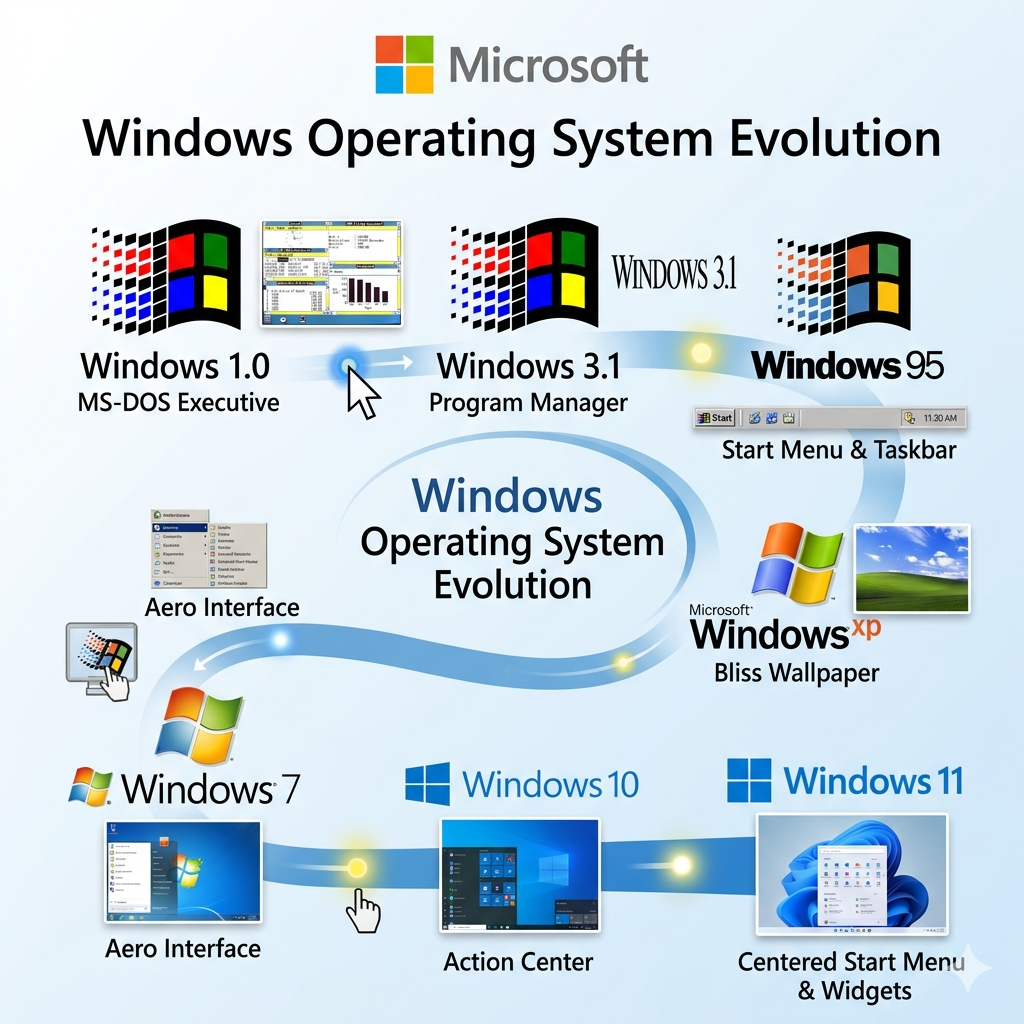
Key Details of
Windows Operating System
Windows 1.0
Windows 1.0 is a graphical operating environment released by Microsoft in November 1985. It marked the company’s first major attempt to bring a visual, mouse-driven interface to personal computers running MS-DOS, introducing the foundation for what became the widely used Windows family of operating systems.
Key facts
- Release date: November 20, 1985
- Developer: Microsoft
- Platform: IBM PC-compatible systems
- Interface type: 16-bit graphical shell over MS-DOS
- End of support: December 31, 2001
Development and background
Windows 1.0 was conceived to provide users with multitasking and graphical capabilities unavailable in command-line DOS. It ran on top of MS-DOS rather than replacing it, using a cooperative multitasking model. Early development began in 1981 under the codename “Interface Manager,” with Bill Gates positioning it as a response to the graphical innovations of Apple’s Lisa and Macintosh systems.
Windows 2.0
Windows 2.0 is a graphical operating environment released by Microsoft in December 1987. Designed to run on top of MS-DOS, it built upon the foundation of Windows 1.0 by introducing overlapping windows, improved graphics handling, and better hardware support. It marked a step toward the multitasking and interface paradigms later refined in Windows 3.x.
Key facts
- Release year: 1987
- Platform: IBM PC and compatibles
- Kernel base: MS-DOS graphical shell
- Major feature: Overlapping and resizable windows
- Successor: Windows 3.0 (1990)
Windows 3.0
Windows 3.0 is a 16-bit graphical operating environment released by Microsoft on May 22, 1990, running on top of MS-DOS. It introduced a redesigned interface, enhanced memory management, and multitasking that made personal computing more approachable and set the stage for the later dominance of the Windows family.
Key facts
- Developer: Microsoft
- Initial release: May 22, 1990
- Latest update: 3.00a (October 1991)
- System requirements: Intel 80286 or better, ≥1 MB RAM, MS-DOS 3.1+
- Succeeded by: Windows 3.1
Windows 95
Windows 95 is a consumer operating system developed by Microsoft and released in 1995. It marked a major redesign of the Windows interface and architecture, combining graphical ease of use with improved multitasking. The release redefined personal computing and became a landmark in desktop operating system history.
Key facts
- Developer: Microsoft
- Initial release: August 24, 1995
- Kernel type: Hybrid 16-/32-bit
- Successor: Windows 98
- Notable feature: Introduced the Start menu and taskbar
Design and features
Windows 95 introduced a unified graphical shell integrating the Program Manager and File Manager into a single desktop environment. The Start menu, taskbar, and system tray provided quick navigation and program management that remain core to Windows today. It supported long filenames and Plug and Play hardware detection, simplifying device installation for users.
Windows 98
Windows 98 is a consumer operating system developed by Microsoft and released in 1998 as the successor to Windows 95. Built on the MS-DOS–based Windows 9x architecture, it enhanced system stability, plug-and-play hardware support, and internet integration during the early era of widespread personal computing.
Key facts
- Developer: Microsoft
- Initial release: June 25, 1998
- Kernel type: Hybrid (MS-DOS with 32-bit Windows layer)
- Successor: Windows Me
- Last support end: July 11, 2006
Windows Me
Windows Millennium Edition (Windows Me) is a consumer operating system developed by Microsoft, released worldwide on September 14, 2000 as the last version of the DOS-based Windows 9x family. Intended as an upgrade to Windows 98 Second Edition, it added multimedia, networking, and system-recovery features but was widely criticized for instability and short-lived support.
Key facts
- Release date: September 14, 2000
- Kernel type: Hybrid, DOS-based
- Successor: Windows XP (October 2001)
- End of support: July 11, 2006
- Notable firsts: System Restore, Windows Movie Maker, AutoUpdate
Design and purpose
Windows Me targeted home PC users, emphasizing digital media and “PC Health”. It introduced tools for video editing, music playback, and automated maintenance. The interface borrowed elements from Windows 2000, while removing full access to real-mode DOS to speed boot time—reducing backward compatibility with legacy applications.
Windows 2000
Windows 2000 is an operating system developed by Microsoft as part of the Windows NT family. Released in February 2000, it marked a major step in bringing NT’s business-grade stability to mainstream desktop and server environments, bridging consumer and enterprise computing before Windows XP unified the product lines.
Key facts
- Developer: Microsoft
- Initial release: February 17, 2000
- Kernel type: Hybrid (Windows NT 5.0)
- Editions: Professional, Server, Advanced Server, Datacenter Server
- Successor: Windows XP (2001)
Development and Architecture
Windows 2000 was built on the NT 5.0 kernel, inheriting preemptive multitasking and memory protection from earlier NT versions. It supported the NTFS 3.0 file system, Plug and Play hardware detection, and an improved driver model. These foundations provided the stability and security framework that influenced later Windows releases.
Windows XP
Windows XP is a personal computer operating system developed by Microsoft, released to manufacturing in August 2001 and to the public in October 2001. It unified Microsoft’s consumer and business Windows product lines on a single NT-based architecture, becoming one of the most widely adopted operating systems in history.
Key facts
- Developer: Microsoft Corporation
- Initial release: October 25, 2001
- Kernel type: Hybrid (Windows NT 5.1)
- Major editions: Home, Professional, Media Center, Tablet PC, x64
- End of extended support: April 8, 2014
Development and features
Windows XP (short for eXPerience) replaced Windows 2000 and Windows Me, combining their strengths into one platform. It introduced a significantly redesigned user interface with the Luna visual style, fast user switching, remote desktop capability, and improved multimedia and networking support. Built on the NT kernel, XP brought greater stability and security to home users while maintaining business-class functionality.
Editions and updates
Microsoft released several specialized editions, including Windows XP Professional x64 Edition, Media Center Edition, and Tablet PC Edition. The system received three major Service Packs (SP1–SP3) that added USB 2.0 support, firewall enhancements, and security improvements such as the Security Center. XP’s lifecycle officially ended in 2014, though embedded variants continued to receive limited updates afterward.
Windows Vista
Windows Vista is a computer operating system developed by Microsoft and released to consumers in January 2007. It succeeded Windows XP and introduced major visual, security, and system-architecture changes. Though initially praised for innovation, Vista faced criticism over performance and compatibility that influenced its replacement by Windows 7 two years later.
Key facts
- Release date: January 30, 2007
- Latest service pack: Service Pack 2 (2009)
- Kernel version: NT 6.0
- Editions: Starter, Home Basic, Home Premium, Business, Enterprise, Ultimate
- Support ended: Extended support concluded April 11, 2017
Development and design goals
Windows Vista focused on improving security, reliability, and user experience. It introduced the Aero Glass graphical interface, the User Account Control (UAC) system for elevation of privileges, and a new search-centric Start menu. Core system changes included the Windows Display Driver Model, SuperFetch memory management, and ReadyBoost support for USB flash acceleration. The release also debuted Windows Defender as a built-in antispyware component.
Compatibility and updates
Many early users encountered hardware-driver and software-compatibility issues, prompting a series of Windows Vista Application Compatibility Updates. Later service packs and the Platform Update for Windows Vista added technologies back-ported from Windows 7 such as Direct2D, DirectWrite, and improved device-support APIs【turn0search7】.
Windows 7
Windows 7 is a personal computer operating system developed by Microsoft and released to manufacturing in July 2009. It succeeded Windows Vista and quickly became one of Microsoft’s most popular OS versions, praised for its stability, performance, and refined interface.
Key facts
- Developer: Microsoft
- Initial release: October 22, 2009
- Kernel version: NT 6.1 (Build 7601 for SP1)
- Latest service pack: Service Pack 1 (2011)
- Support ended: January 14, 2020
Updates and successor
Windows 7 Service Pack 1 (2011) consolidated early patches and added stability fixes. Later “Convenience Rollups” and update clients improved Windows Update performance. Microsoft promoted free upgrades to Windows 10 after 2015, marking the transition toward unified, continuously updated Windows platform
Windows 8
Windows 8 is a major version of the Microsoft Windows line, released by Microsoft in 2012. It introduced a touch-optimized interface and reimagined the desktop to bridge PCs and mobile devices. The system represented Microsoft’s effort to unify traditional computing with tablets and hybrid hardware.
Key facts
- Initial release: October 26, 2012
- Editions: Core, Pro, Enterprise, RT
- Kernel version: NT 6.2
- Default browser: Internet Explorer 10
- Successor: Windows 8.1
Design and interface
Windows 8 introduced the “Metro” (later “Modern”) interface, built around dynamic tiles that update in real time. This design replaced the long-standing Start menu with a full-screen Start screen optimized for touch gestures. Despite this, the familiar desktop environment remained available for legacy applications. The system also integrated tightly with Microsoft account logins, enabling cloud synchronization across devices via OneDrive.
Features and functionality
The OS shipped with native “apps” for mail, photos, music, and video, and introduced the Windows Store for digital software distribution. It supported both x86 and ARM architectures, the latter through Windows RT. Security tools such as Windows Defender and SmartScreen were expanded, and fast boot performance was achieved through hybrid shutdown technology.
Windows 8.1
Windows 8.1 is an operating system developed by Microsoft and released globally in October 2013. It served as both an update and successor to Windows 8, aiming to refine its touch-centric interface while restoring usability features familiar to desktop users. Windows 8.1 introduced key interface changes, improved cloud integration, and expanded hardware support.
Key facts
- Developer: Microsoft Corporation
- Initial release: October 17, 2013
- Latest update: January 2023 (end of extended support)
- Default browser: Internet Explorer 11
- Successor: Windows 10
Design and interface
Windows 8.1 refined the controversial design of its predecessor by reintroducing the Start button and allowing direct boot to the desktop. It continued the “Modern UI” (formerly Metro) tile-based Start screen, optimized for both touch and traditional mouse-keyboard use. Users gained greater personalization with adjustable tile sizes and improved multitasking—supporting up to four apps on-screen simultaneously, depending on display size.
Features and functionality
Windows 8.1 deepened integration with cloud services through OneDrive (formerly SkyDrive), enabling file sync and backup across devices. The update shipped with Internet Explorer 11, faster boot times, built-in security via Windows Defender, and native support for Wi-Fi Direct, 3D printing, and high-resolution displays. It also expanded the Windows Store, allowing easier app discovery and updates.
Editions and compatibility
The OS was offered in several editions—Core, Pro, and Enterprise, as well as RT 8.1 for ARM-based tablets. It was available in 32-bit and 64-bit versions and supported seamless upgrades from Windows 8 without reinstalling applications. OEM partners like Sony and Dell preinstalled Windows 8.1 on PCs, laptops, and hybrid devices.
Windows 10
Windows 10 is an operating system developed by Microsoft and released in July 2015. It unified Microsoft’s computing platforms under a single software family spanning PCs, tablets, and embedded systems. The OS emphasized security, speed, and cross-device integration, becoming one of the most widely used desktop operating systems globally.
Key facts
- Developer: Microsoft
- Initial release: July 29, 2015
- Latest major update: October 2022 (22H2)
- Predecessor: Windows 8.1
- Successor: Windows 11
Design and features
Windows 10 reintroduced the familiar Start Menu while merging elements of the tile-based Windows 8 interface. It featured a hybrid design suited for both mouse/keyboard and touch input. Built-in features included the digital assistant Cortana, the Edge web browser, virtual desktops, and universal apps designed to run across device types.
Security and updates
The operating system adopted a “Windows as a Service” model, providing continuous updates rather than distinct new versions. Key security enhancements included Windows Hello for biometric sign-in, Windows Defender for integrated malware protection, and automatic background updates to maintain system integrity and threat resilience.
Editions and deployment
Windows 10 was available in multiple editions—Home, Pro, Enterprise, and Education—tailored for different user groups. It supported deployment through retail purchase, OEM installation, or enterprise volume licensing. The OS was also offered as a free upgrade for eligible Windows 7 and Windows 8.1 users during its first year.
Reception and legacy
Windows 10 was praised for its improved interface, speed, and regular update model, though its telemetry and forced updates drew privacy concerns. It remained dominant in the PC market until being gradually succeeded by Windows 11 starting in 2021.
Windows 11
Windows 11 is a personal computer operating system developed by Microsoft and officially released on October 5, 2021. It is the successor to Windows 10, designed to offer a cleaner interface, tighter integration with cloud and AI tools, and enhanced performance and security for modern hardware.
Key facts
- Developer: Microsoft
- Initial release: October 5, 2021
- Latest major update: 2024 (as of 2025)
- Editions: Home, Pro, Enterprise, Education, and SE
- Support for Windows 10 ends: October 14, 2025
Design and user experience
Windows 11 introduces a centered taskbar, redesigned Start menu, rounded window corners, and a consistent aesthetic influenced by the Fluent Design System. Widgets return as a customizable information feed, and Snap Layouts simplify window organization. The Microsoft Store was rebuilt for speed and broader app compatibility, including Android app support via Amazon Appstore.
Features and productivity
The OS focuses on hybrid work and personal productivity. Microsoft Teams is built directly into the taskbar for instant communication. AI-assisted tools such as Copilot integrate with search and settings. Virtual desktops, DirectStorage for gaming, and improved touchscreen and stylus support further enhance versatility .
Security and performance
Windows 11 requires modern security hardware—Trusted Platform Module (TPM) 2.0, Secure Boot, and virtualization-based protection—to guard against malware and firmware attacks. It is marketed as Microsoft’s most secure Windows yet, maintaining built-in antivirus, firewall, and phishing defenses active throughout the device’s lifecycle .
Installation and availability
Eligible Windows 10 devices can upgrade via Windows Update, the Installation Assistant, or bootable installation media. Microsoft advises confirming hardware compatibility with the PC Health Check app before upgrading. Windows 11 is also preinstalled on most new PCs from 2021 onward
Developer Description
ISO/ROM/File Download
- Window 1.0 https://archive.org/details/win-1.0_202409
- Windows 2.0 https://archive.org/details/windows-2.0-iso_202506
- Windows 3.0 https://archive.org/details/windows_3.00_english_with_ms-dos_6.22_eng
- Windows 95 https://archive.org/details/win-95-osr-2
- Windows 98 https://archive.org/details/windows-98-se-isofile
- Windows ME https://archive.org/details/windows_me_final_oem_en-de-ru-tr_x86
- Window 2000 https://archive.org/details/win2kproiso
- Windows XP https://www.microsoft.com/en-us/software-download/windowsxp
- Windows Vista https://www.microsoft.com/en-us/software-download/windowsvista
- Windows 7 https://www.microsoft.com/en-us/software-download/windows7
- Windows 8 https://www.microsoft.com/en-us/software-download/windows8ISO
- Windows 8.1 https://www.microsoft.com/en-us/software-download/windows8ISO
- Windows 8.1 https://www.microsoft.com/en-us/software-download/windows8ISO
- Windows 10 https://www.microsoft.com/en-us/software-download/windows10
- Windows 11 https://www.microsoft.com/en-in/software-download/windows11
Connect with Us: Follow us on social media for updates, tips, and behind-the-scenes content:
- 🌐 Visit My Website: https://ayogoeeth.com
- 🌐 Visit My Website: https://johar.christianessentials.in/
- 🌐 Visit My Website: https://shop.ayogoeeth.com
- 🌐 Visit My Website: https://sarkarijob2024.ayogoeeth.com
- 🌐 Visit My Website: https://church.christianessentials.in/
- 🌐 Visit My Website: https://christianessentials.in/
- Medium: https://medium.com/@agmmmbsnlwb
- Pinterest: https://in.pinterest.com/agmmmbsnlwb/
- Twitter: https://twitter.com/SantoshSor87185
- Facebook: https://www.facebook.com/santosh.soreng.771