
Church Poll Manager

A printer is an electronic output device that converts digital information (from a computer, mobile, or other devices) into a hard copy on paper or other materials. Types and Manufacturers 1. Inkjet Printers Description:Inkjet printers spray tiny droplets of ink onto paper. They are best for home use, photo printing, and low-volume printing. Key Features: Low initial cost High-quality color printing Slower than laser printers Popular Manufacturers: HP (DeskJet, Ink Tank, OfficeJet) Canon (PIXMA series) Epson (EcoTank, Expression) 2. Laser Printers Description:Laser printers use toner powder and laser technology. Ideal for offices and bulk printing. Key Features: Fast printing speed Low cost per page Best for text documents Popular Manufacturers: Brother Industries (HL, MFC series) HP (LaserJet series) Canon (imageCLASS) 3. All-in-One (Multifunction) Description:These combine printing, scanning, copying, and faxing in one device. Key Features: Space-saving Ideal for offices and homes Wireless connectivity Manufacturers: HP Smart Tank / OfficeJet Canon
Graphics Drivers for Windows: Evolution, Intel vs AMD Comparison, Pros & Cons Graphics drivers are one of the most critical components of any Windows system. Whether you’re gaming, editing videos, or simply browsing, the graphics driver acts as a bridge between your operating system and the GPU (Graphics Processing Unit). In this blog post, we will explore: The evolution of graphics drivers Intel graphics driver history AMD graphics driver history Latest technologies Comparison (Intel vs AMD) Pros and Cons What is a Graphics Driver? A graphics driver is software that allows the operating system (Windows) to communicate with the graphics hardware. Without it, your system would only display basic visuals using generic drivers. Modern drivers: Improve performance Fix bugs Add support for new games and apps Enable advanced features like ray tracing, AI upscaling, etc. Evolution of Graphics Drivers (Windows Era) Early Era (Windows XP & Before) Basic drivers with
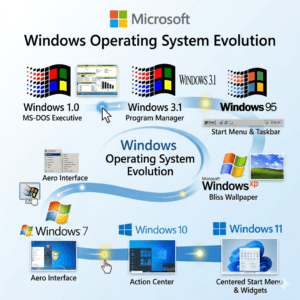
Microsoft Windows Operating System Evolution Overview Windows 1.0 Windows 1.0 is a graphical operating environment released by Microsoft in November 1985. It marked the company’s first major attempt to bring a visual, mouse-driven interface to personal computers running MS-DOS, introducing the foundation for what became the widely used Windows family of operating systems. Key facts Release date: November 20, 1985 Developer: Microsoft Platform: IBM PC-compatible systems Interface type: 16-bit graphical shell over MS-DOS End of support: December 31, 2001 Development and background Windows 1.0 was conceived to provide users with multitasking and graphical capabilities unavailable in command-line DOS. It ran on top of MS-DOS rather than replacing it, using a cooperative multitasking model. Early development began in 1981 under the codename “Interface Manager,” with Bill Gates positioning it as a response to the graphical innovations of Apple’s Lisa and Macintosh systems. User interface and features The system displayed tiled windows (not overlapping) and supported basic applications